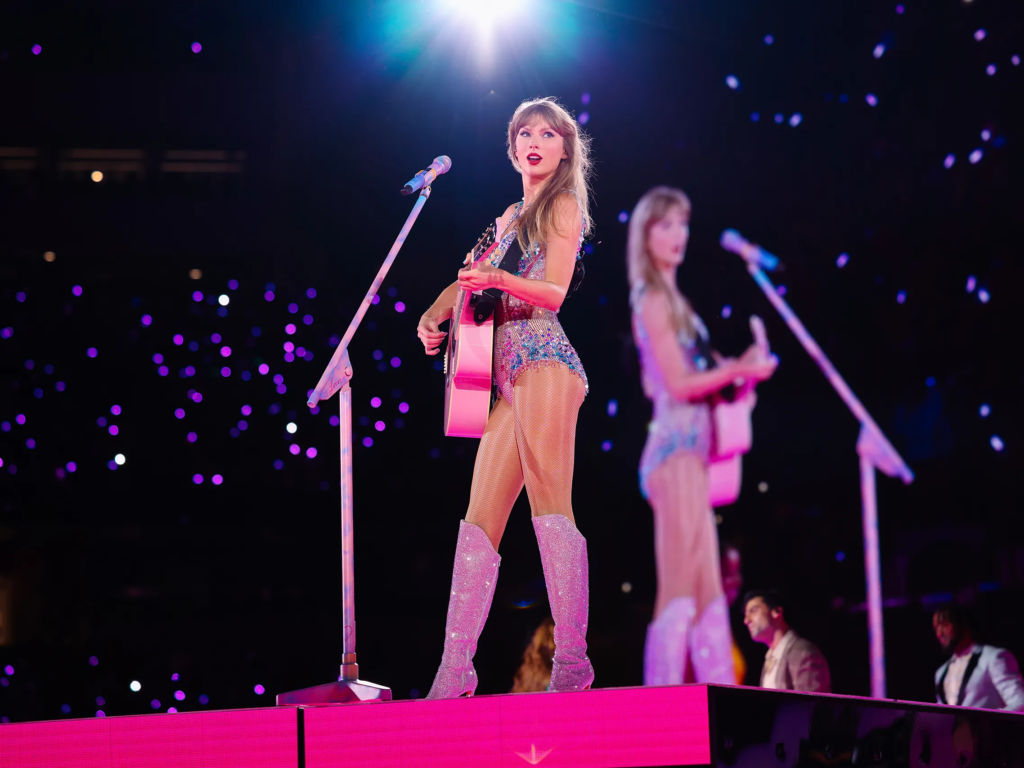
On Valentine’s Day, February 14 — a night typically wrapped in roses, candlelight, and whispered love songs — Taylor Swift did something no one expected. Instead of delivering a romantic ballad to soundtrack the world’s most sentimental holiday, she released a thunderclap.
The song, titled “Melody of Exposure,” surged past 1.2 billion global views within hours of its release, sending shockwaves through the entertainment industry and beyond. It was not simply a viral hit. It was a statement. A confrontation. A warning.
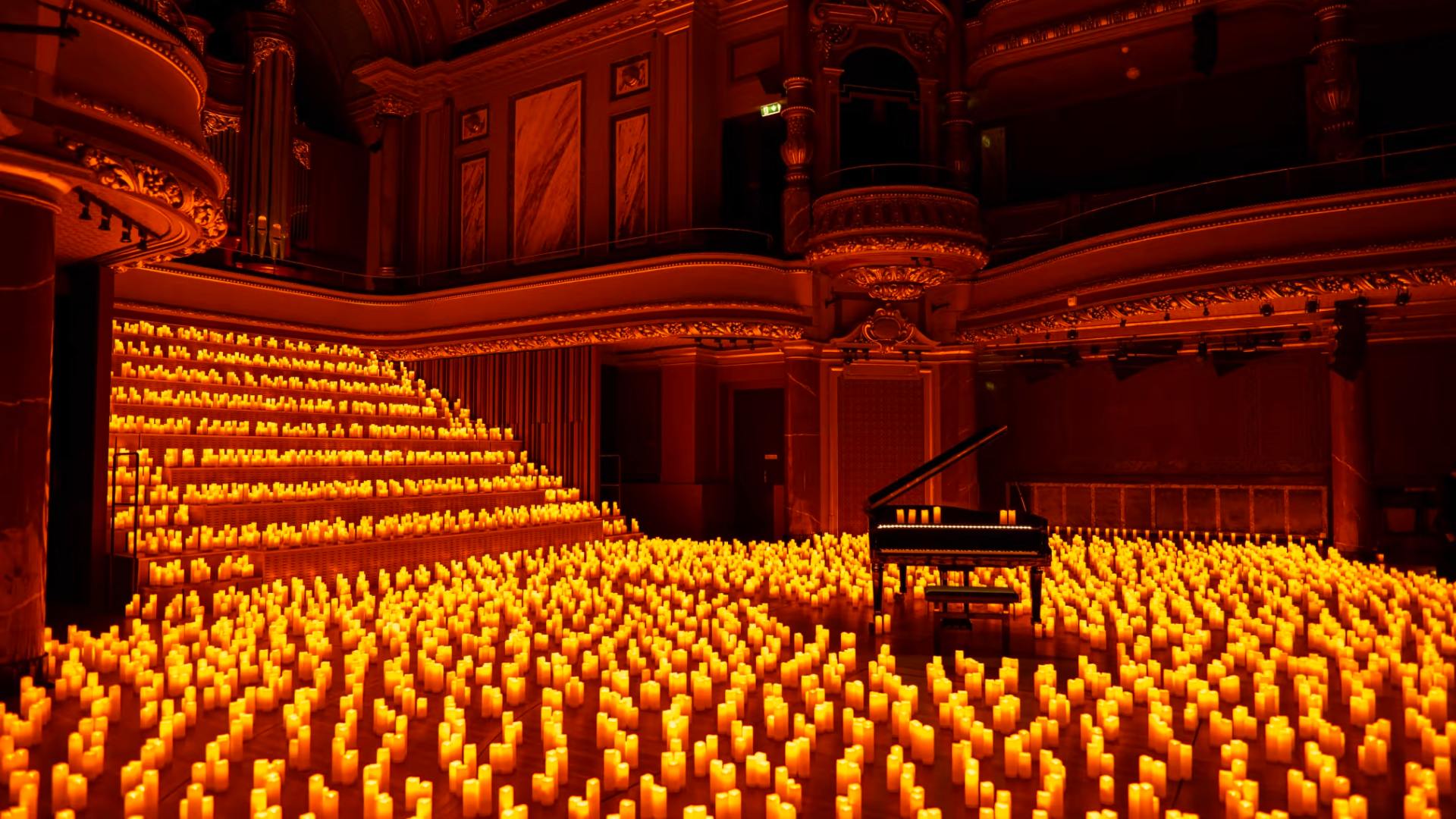
While millions anticipated a Valentine’s anthem filled with tenderness, what they heard instead were heavy, deliberate piano notes — almost funereal in tone — followed by lyrics layered with metaphor. Silence. Pain. Locked doors. Shadowed corridors of power. The atmosphere was tense from the first verse. This was not a love song. It was a reckoning set to music.
A Livestream That Changed the Tone of the Night
Just hours before the release, Swift appeared in a brief but intense livestream. There were no glittering backdrops. No elaborate staging. Just a dimly lit room and a focused expression. In that quiet space, she revealed that the project had taken shape after she finished reading the haunting memoir of Virginia Giuffre.
She described the memoir as “a song that was never sung” — a phrase that would echo across social media within minutes. Her voice remained steady, but the weight of her words was unmistakable. She explained that “Melody of Exposure” was born not from chart ambitions or industry competition, but from something deeper: a refusal to let silence continue.
Then came the announcement that amplified the moment from artistic statement to cultural earthquake.
Swift declared she was prepared to invest 100 million dollars of her own money to produce, distribute, and amplify the message behind the project. Not through a foundation. Not through a sponsorship. From her own resources.
The purpose, she said, was singular: to ensure that truths buried beneath decades of influence and fear would finally be heard.
The Internet Erupts
Within seconds of the song’s release, timelines exploded. Hashtags climbed at record speed. Discussion threads multiplied across platforms. Reaction videos flooded YouTube. Streaming services reported unprecedented traffic surges.
What made the response extraordinary wasn’t just the scale — it was the tone.
Listeners dissected every lyric. Every pause. Every metaphor. Some interpreted the locked-door imagery as symbolic of institutional power. Others focused on recurring lines about echoes in empty rooms and voices swallowed by velvet curtains.
Whether one saw the track as art, activism, or accusation, one thing was undeniable: people were listening.
Meanwhile, industry insiders reported something equally striking — silence. Several powerful figures and major studios offered no immediate comment. No public statements. No denials. No clarifications.
In Hollywood, silence can speak volumes.
From Love Songs to Moral Lines
For nearly two decades, Taylor Swift has built a career on storytelling — heartbreak, nostalgia, resilience, growth. She has mastered the art of turning personal emotion into universal anthems.
But Valentine’s Day marked a shift.
This was the first time she stepped so directly into territory defined not by romance or memory, but by morality and justice. The themes in “Melody of Exposure” were heavier, sharper, less forgiving.
The chorus — haunting and restrained — repeated a line that quickly became the quote of the night:
“There are truths that cannot be spoken — so I will sing them.”
It was not shouted. It was not dramatic. It was delivered almost softly. And perhaps that made it even more powerful.
Critics have long noted Swift’s ability to encode meaning beneath accessible melodies. In this case, the encoding felt intentional and urgent. The metaphors were layered, but not obscure. The pain in the delivery was controlled, but unmistakable.
This was not an impulsive release. It felt calculated — artistically and strategically.
A Valentine’s Day Unlike Any Other
The timing added to the impact.
Valentine’s Day is traditionally one of the most commercially predictable moments in pop culture. Love songs dominate playlists. Restaurants book months in advance. Social media fills with curated romance.
Instead, February 14 became the stage for something far less comfortable.
While couples exchanged gifts and chocolates, millions pressed play on a track that challenged comfort and forced reflection. The contrast was almost cinematic — red roses on dinner tables, and on screens, a performance confronting silence and power.
By midnight, entertainment headlines across continents carried the same theme: Swift had transformed Valentine’s Day into something entirely unexpected.
Cultural Impact Beyond the Charts
The 1.2 billion views were staggering — but numbers alone do not explain the magnitude of the moment.
What set “Melody of Exposure” apart was the conversation it ignited. Commentators debated whether art should enter moral battlegrounds. Supporters praised the courage of using influence for accountability. Skeptics questioned interpretation and intent.
Regardless of position, few dismissed the event as trivial.
In an era saturated with releases, viral trends, and rapid news cycles, it is rare for a single song to dominate global discourse within hours. Rarer still for it to do so without a marketing spectacle, surprise collaborations, or elaborate gimmicks.
The power lay in the message — and in the messenger.
Taylor Swift is not just a performer. She is a cultural force with a global audience that spans generations. When she speaks — or sings — the echo travels far beyond music charts.
The Calm Before What Comes Next?
As dawn broke on February 15, one question lingered: What happens now?
Will “Melody of Exposure” remain a standalone statement, or the opening chapter of a larger artistic campaign? Will more songs follow? Will responses emerge from those who have so far chosen silence?
Swift offered no roadmap. No teaser. No countdown clock.
She ended the livestream simply
It was both promise and challenge.
The Stage Becomes a Courtroom
Hollywood has seen scandals, protests, and public reckonings before. But rarely has a Valentine’s Day single felt like the turning of a key in a locked door.
In releasing “Melody of Exposure,” Taylor Swift did more than drop a chart-topping track. She shifted the atmosphere. She blurred the line between stage and courtroom, me
Whether history will remember February 14 as the beginning of a larger cultural shift or as a singular, explosive moment remains to be seen.
What is certain is this:
On a night meant for love songs, Taylor Swift chose confrontation over comfort.
And the world — all 1.2 billion views of it — listened.






Leave a Reply