Late on a recent evening, a video labeled as a “bombshell” began circulating across social platforms, promising a moment of live television so explosive that it would leave Donald Trump visibly shaken. The clip’s premise was simple and irresistible: Barack Obama, calm and deliberate, confronting Donald Trump at a black-tie gala with revelations so grave that they demanded an immediate reckoning. Within hours, the video had racked up millions of views, accompanied by captions describing panic, ultimatums, and a room plunged into chaos.
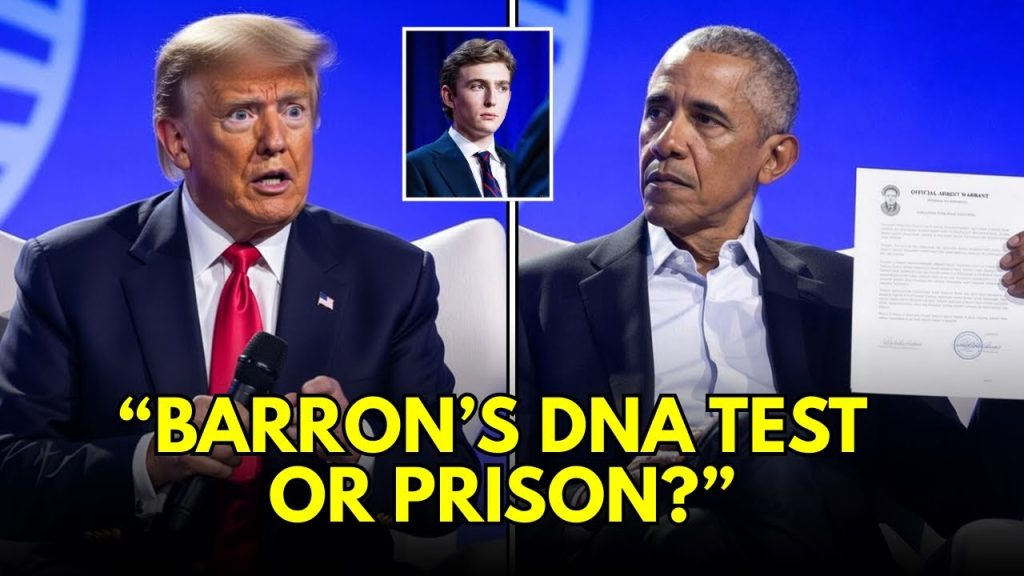
The power of the clip lies less in what it proves than in how it performs. Set in a glittering ballroom—chandeliers blazing, cameras trained on the nation’s most recognizable political figures—the scene is constructed as a morality play. Obama is framed as the embodiment of restraint and legality, Trump as a man cornered by secrets. The camera language is familiar: tight close-ups, reaction shots, prolonged silences. The audience is guided to feel that history is unfolding in real time.
Yet a closer look reveals something else at work. The video does not present verifiable documentation, contemporaneous reporting, or independent corroboration. Instead, it offers a narrative—highly specific, emotionally charged, and cinematic—designed to collapse the distance between allegation and conclusion. The effect is not investigative journalism but viral dramaturgy.

This distinction matters. American political culture has always made room for spectacle, but the digital era has blurred the line between reporting and performance. In the clip, Obama’s alleged “reveal” is framed as a legal ultimatum delivered on live television. The claim is extraordinary; the evidence, as shown, is not. The camera lingers on faces, not files. The tension is generated through pacing and implication rather than substantiation.
What viewers respond to is the archetype. Obama, who for years has represented composure in contrast to Trump’s volatility, is cast as the quiet executor of accountability. Trump, whose public persona depends on dominance and control, is shown losing both. The story satisfies a narrative hunger: the idea that restraint ultimately defeats bluster, that secrets collapse under light.
That hunger explains the clip’s reach. It is less about a single allegation than about a broader cultural desire for moral clarity in a landscape saturated with noise. The video promises that clarity through a single, decisive moment—a fourteen-second countdown, a choice presented, a reckoning delivered. In doing so, it compresses years of political conflict into a scene that feels final.
But politics rarely resolves itself in such clean arcs. The real work of accountability is slow, procedural, and often anticlimactic. It unfolds in court filings, committee hearings, and investigative reports, not gala confrontations staged for maximum effect. By replacing process with performance, viral clips risk confusing emotional resolution with factual resolution.
This is not to say that satire, dramatization, or political storytelling lack value. They can illuminate power dynamics and expose contradictions. They can sharpen public attention. But when presented as reportage—when the language of proof is borrowed without the discipline of verification—the result is distortion. Viewers are invited to feel informed when they are, in fact, entertained.
The reaction cycle that follows is predictable. Supporters share the clip as confirmation; critics dismiss it as fabrication; the undecided are left with an impression rather than an understanding. The algorithm rewards intensity, not accuracy. Each share reinforces the spectacle.
What endures after the initial shock is not the specific claim but the image: Trump rattled, Obama unflinching. That image fits a long-running narrative about the two men, and it is why the video travels. It tells audiences what they already suspect about character and power. In that sense, its success is less about persuasion than reinforcement.
The danger lies in habituation. When audiences grow accustomed to “bombshells” that arrive fully formed and resolve themselves within minutes, patience for genuine reporting erodes. The slow accumulation of facts begins to feel unsatisfying by comparison. Theatrics become the standard.
The clip’s creators understand this. They lean on the aesthetics of authority—formal venues, solemn tones, legal language—without submitting to the constraints that authority requires. The result is a hybrid form: political fiction presented with the cadence of news.
In the end, the question raised by the video is not whether Trump “erupted” or whether Obama “dropped” anything definitive. It is whether the public can still distinguish between revelation and representation. Democracy depends on that distinction. Without it, the loudest story wins, regardless of its grounding.
The ballroom fades, the cameras cut explaining nothing further, and viewers are left with a feeling rather than a fact. That may be enough for a viral moment. It is not enough for the truth.
Leave a Reply